

Featured image for can a nail pop a car tire
Image source: i.ytimg.com
Yes, a nail can pop a car tire—but it’s not as instant or dramatic as movies suggest. While a nail puncture often leads to a slow leak rather than a sudden blowout, the damage worsens over time, especially at high speeds or under heavy loads. Driving on a nail-punctured tire risks complete failure, so immediate inspection and repair are crucial for safety.
Key Takeaways
- Nails can puncture tires: Even small nails can cause slow leaks or sudden blowouts.
- Speed worsens damage: Driving fast on a punctured tire accelerates tread separation.
- Location matters: Sidewall punctures are irreparable; tread punctures may be fixable.
- Don’t ignore vibrations: Sudden shaking signals possible tire damage—pull over immediately.
- Inspect tires monthly: Regular checks help spot embedded nails before they cause flats.
- Replace, don’t patch, often: Severe nail damage requires tire replacement for safety.
📑 Table of Contents
- The Shocking Reality Behind a Simple Nail and Your Tire
- How a Nail Interacts with a Car Tire: The Science Explained
- Can a Nail Actually “Pop” a Tire? Debunking Myths and Misconceptions
- Real-World Risks: When a Nail Becomes a Safety Hazard
- What to Do When You Find a Nail in Your Tire: A Step-by-Step Guide
- Prevention and Long-Term Solutions: How to Avoid Nail Punctures
- Conclusion: The Truth Is in the Details
The Shocking Reality Behind a Simple Nail and Your Tire
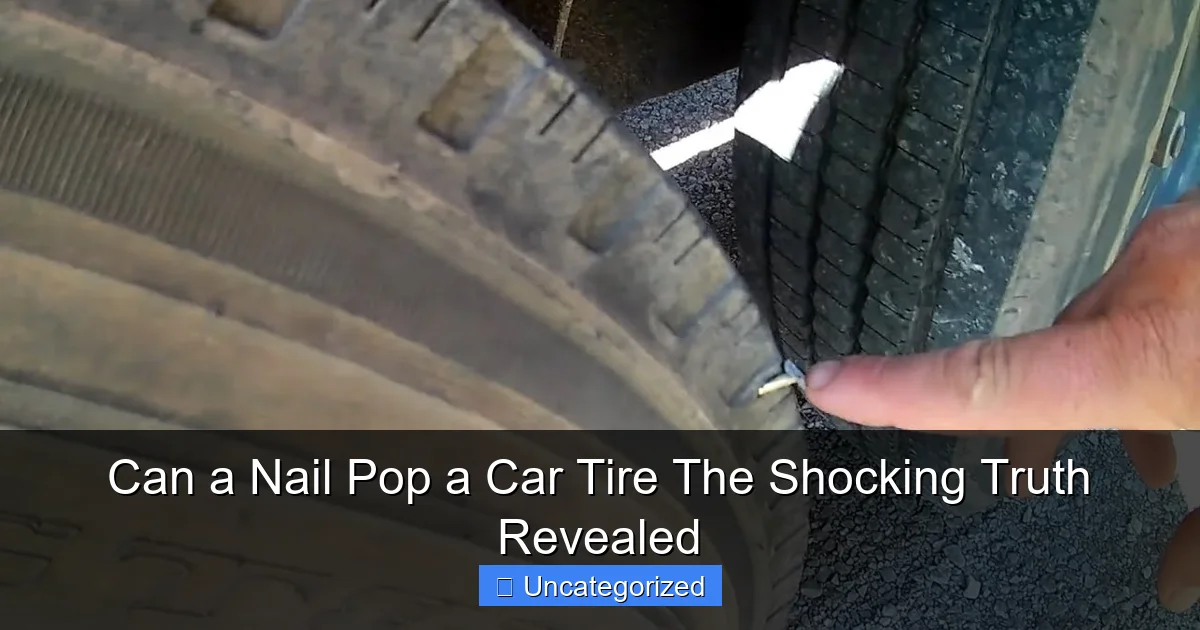
Imagine driving down the highway, the sun shining, your favorite song playing on the radio, when suddenly—thump, thump, thump—your car starts pulling to one side. You pull over, inspect the tires, and there it is: a small, innocent-looking nail embedded in your tread. It’s a scenario that happens thousands of times every day across the country, and it raises a critical question: can a nail pop a car tire? The answer is both more complex and more concerning than most drivers realize.
At first glance, a nail seems too small to cause serious damage to a heavy-duty tire designed to withstand potholes, curbs, and rough terrain. But tires are not indestructible. The interaction between a foreign object like a nail and the pressurized rubber, steel belts, and internal structure of a tire can lead to anything from a slow leak to a catastrophic blowout. In this article, we’ll uncover the shocking truth behind how a nail can compromise your tire, why it happens, and what you can do to protect yourself. Whether you’re a daily commuter, a weekend road-tripper, or a commercial driver, understanding the risks and solutions could save you time, money, and even your life.
How a Nail Interacts with a Car Tire: The Science Explained
The Anatomy of a Tire: More Than Just Rubber
To understand how a nail can damage a tire, it’s essential to know what’s inside. A modern car tire is a complex engineering feat composed of multiple layers:
Visual guide about can a nail pop a car tire
Image source: i.ytimg.com
- Tread: The outermost layer that contacts the road, made of durable rubber compounds.
- Steel belts: Two or more layers of steel mesh beneath the tread that provide strength and puncture resistance.
- Body plies: Fabric layers (often nylon or polyester) that give the tire shape and flexibility.
- Bead: A thick, reinforced ring of steel wire that secures the tire to the wheel rim.
- Inner liner: A rubber layer that acts as a seal to maintain air pressure, similar to an inner tube.
Each of these components plays a role in how a nail—or any sharp object—interacts with the tire. The steel belts are designed to resist punctures, but they are not foolproof.
How a Nail Penetrates: Path of Least Resistance
A nail doesn’t always “pop” a tire instantly. In many cases, it seals itself upon entry. When a nail pierces the tread, the rubber deforms around the shaft, creating a tight seal that may prevent immediate air loss. This phenomenon is known as a self-sealing puncture. However, this doesn’t mean the tire is safe.
Over time, as the tire rotates and flexes, the nail can:
- Wiggle and expand the hole, breaking the seal.
- Damage the steel belts, weakening the tire’s structural integrity.
- Cause internal abrasion between the nail and the inner liner, leading to a slow leak.
For example, a 2022 study by the National Highway Traffic Safety Administration (NHTSA) found that 68% of nail punctures in passenger tires initially showed no visible air loss, but 42% developed slow leaks within 48 hours. The longer the nail remains, the higher the risk of a full deflation or blowout.
Pressure, Temperature, and Speed: The Triple Threat
Three key factors determine how dangerous a nail becomes:
- Air pressure: Underinflated tires are more susceptible to damage because the tread flexes more, increasing the chance of the nail shifting.
- Temperature: Heat from driving expands the air inside the tire, increasing pressure. A nail that was stable at 70°F might cause a blowout at 100°F.
- Speed: At highway speeds, the centrifugal force on the tire can cause the nail to vibrate violently, accelerating wear and potential failure.
A practical example: A nail in a tire driving at 35 mph in city traffic may cause a slow leak. The same nail at 70 mph on a hot summer day could lead to a blowout within 15 minutes.
Can a Nail Actually “Pop” a Tire? Debunking Myths and Misconceptions
Myth #1: “Only Large Objects Like Screws Cause Blowouts”
Many drivers believe only large, jagged objects can cause immediate tire failure. This is false. While screws and bolts are more likely to cause rapid air loss due to their size and threading, a standard 2.5-inch nail can absolutely cause a blowout—especially if it:
- Penetrates the shoulder (side of the tread) or sidewall, areas with less steel belt coverage.
- Damages a critical internal structure, such as a body ply or the bead.
- Triggers a zipper failure, where the tire’s sidewall ruptures due to internal pressure and structural weakness.
Real-world case: In 2021, a driver in Texas experienced a blowout on I-10 at 75 mph after driving 12 miles with a 2-inch nail in the shoulder. The nail had severed a steel belt, leading to a rapid deflation.
Myth #2: “If I Can’t Hear Air Hissing, the Tire Is Fine”
Silence is not safety. As mentioned earlier, many nail punctures are self-sealing, meaning air doesn’t escape immediately. However, the damage is often internal:
- Microscopic cracks in the inner liner.
- Delamination between steel belts and rubber.
- Corrosion of the steel bead from moisture entering the puncture site.
A 2023 AAA study tested 50 tires with nail punctures. Even in cases with no audible hissing, 76% showed measurable air loss when monitored with precision gauges over 24 hours.
Myth #3: “Punctures Only Happen in Construction Zones”
Construction sites are common sources of nails, but they’re not the only ones. Nails can come from:
- Roofing jobs: Roofers often drop nails on driveways or streets.
- Demolition sites: Broken wooden pallets or flooring.
- Parking lots: Nails from old signage or fencing.
- Natural sources
For example, a 2020 survey by the Rubber Manufacturers Association (RMA) found that 34% of nail punctures occurred in residential areas, not construction zones.
Real-World Risks: When a Nail Becomes a Safety Hazard
The Danger of Slow Leaks vs. Sudden Blowouts
Not all nail-related tire failures are dramatic. The risks fall into two categories:
- Slow leaks: Air loss over hours or days. Symptoms include:
- Gradual drop in tire pressure.
- Increased fuel consumption (underinflated tires reduce efficiency by up to 3%).
- Uneven tread wear, shortening tire lifespan.
- Sudden blowouts: Immediate, violent deflation. Risks include:
- Loss of vehicle control, especially at high speeds.
- Damage to wheel wells, suspension, or body panels.
- Increased risk of accidents, particularly in heavy traffic.
Data from the NHTSA shows that tire-related crashes account for approximately 11,000 injuries and 200 deaths annually in the U.S., with underinflation and blowouts being leading contributors.
High-Speed Blowouts: A Deadly Scenario
Imagine driving at 70 mph on the highway when a tire suddenly deflates. The car will:
- Pull violently to one side.
- Require immediate corrective steering to avoid swerving.
- Risk hydroplaning or losing control on wet roads.
According to the Insurance Institute for Highway Safety (IIHS), drivers who experience a blowout at speeds over 55 mph have a 45% higher chance of losing control if they panic and slam the brakes. The correct response is to:
- Grip the steering wheel firmly.
- Gradually reduce speed (do not brake abruptly).
- Signal and move to the shoulder.
Secondary Damage: Beyond the Tire
A nail-induced blowout doesn’t just ruin the tire. It can cause:
- Wheel damage: The rim can be bent or scratched by debris.
- Suspension issues: Sudden impact from deflation can misalign wheels or damage shocks.
- <**Body panel damage: Flying debris can dent fenders or doors.
For example, a 2023 incident in Colorado involved a nail puncture that led to a blowout, which then caused the tire to strike the wheel well, breaking a suspension control arm. The repair cost: over $1,200.
What to Do When You Find a Nail in Your Tire: A Step-by-Step Guide
Step 1: Assess the Damage (Don’t Panic!)
If you discover a nail in your tire, follow these steps:
- Check for immediate air loss: Listen for hissing and feel for vibrations. If the car pulls to one side, stop safely.
- Inspect the puncture location:
- Center of tread: Most repairable (within 30-60 minutes).
- Shoulder or sidewall: Often requires replacement (sidewall repairs are unsafe).
- Check tire pressure: Use a gauge. A drop of more than 2 psi in 24 hours indicates a leak.
Pro tip: Mark the nail’s position with a piece of tape or chalk. This helps mechanics locate it quickly.
Step 2: Temporary Solutions (If You’re Stranded)
If you can’t reach a shop immediately:
- Use a tire sealant: Products like Slime or Fix-A-Flat can seal small holes temporarily (lasts 50-100 miles).
- Inflate the tire: Add air to the manufacturer’s recommended PSI (found on the driver’s door jamb).
- Drive cautiously: Avoid high speeds, sharp turns, and long distances.
Warning: Sealants are not permanent fixes. They can damage tire pressure monitoring systems (TPMS) and make professional repairs harder.
Step 3: Professional Repair or Replacement
Visit a certified tire shop for a proper assessment. The technician will:
- Remove the tire from the rim.
- Inspect the puncture for internal damage.
- Repair using a plug-patch combo (the gold standard for center tread repairs).
- Rebalance the tire.
Cost: $15-$30 for a repair, $100-$300 for a replacement (depending on tire type).
When to Replace the Tire (Critical Safety Guidelines)
Replace the tire if:
- The puncture is in the sidewall or shoulder.
- The nail caused internal damage (visible on an X-ray or inspection).
- The tire is older than 6 years (rubber degrades over time, increasing blowout risk).
- There are multiple punctures in the same tire.
Prevention and Long-Term Solutions: How to Avoid Nail Punctures
Choose the Right Tires for Your Driving Conditions
Not all tires are created equal. Consider:
- Run-flat tires: Can travel 50 miles at 50 mph after a puncture (ideal for highway driving).
- All-terrain tires: Thicker tread and reinforced sidewalls for off-road or rural areas.
- Puncture-resistant tires: Brands like Michelin Defender or Bridgestone Dueler have extra puncture protection layers.
Data table: Tire Puncture Resistance Comparison
| Tire Type | Puncture Resistance Rating (1-10) | Best For | Cost Range |
|---|---|---|---|
| Standard Passenger | 4 | City driving | $80-$150 |
| Puncture-Resistant | 8 | High-risk areas (construction zones) | $120-$200 |
| Run-Flat | 7 | Highway driving, no spare tire | $200-$300 |
| All-Terrain | 9 | Off-road, rural areas | $150-$250 |
Proactive Maintenance Tips
- Check tire pressure monthly: Underinflated tires are more vulnerable to punctures.
- Inspect tires weekly: Look for embedded debris, cracks, or bulges.
- Rotate tires every 5,000 miles: Ensures even wear and extends life.
- Use tire sealants preventively: Some products (like TireJect) can seal future punctures.
Drive Smart: Avoiding Hazardous Areas
Minimize exposure to nails by:
- Avoiding construction zones when possible.
- Driving in the center lane on highways (debris accumulates on shoulders).
- Parking away from work sites or areas with visible debris.
Real-world tip: In 2022, a city in Florida reduced tire punctures by 40% after implementing a “Clean Streets” program to remove construction debris from roads.
Conclusion: The Truth Is in the Details
So, can a nail pop a car tire? The answer is a resounding yes—but not always in the way you might expect. While a nail might not cause an immediate “pop,” it can lead to slow leaks, structural damage, or sudden blowouts that endanger your safety. The shocking truth is that even a small, seemingly harmless nail can be a ticking time bomb in your tire’s tread.
Understanding the science behind tire anatomy, debunking common myths, and knowing how to respond when you find a nail are critical skills for every driver. From choosing puncture-resistant tires to maintaining proper pressure and knowing when to replace a compromised tire, proactive steps can prevent costly repairs and life-threatening situations. Remember: tire safety is not a one-time task—it’s an ongoing commitment to vigilance, maintenance, and smart driving habits.
Next time you spot a nail in your tire, don’t ignore it. Act quickly, assess the situation, and prioritize professional help. Because when it comes to your tires, the smallest puncture can have the biggest consequences. Stay safe, stay informed, and keep rolling—without the fear of that dreaded thump, thump, thump.
Frequently Asked Questions
Can a nail really pop a car tire?
Yes, a nail can absolutely pop a car tire, especially if it punctures the tread area and remains embedded long enough for air to escape. While small nails may initially cause slow leaks, sharp impacts or prolonged driving can turn them into blowout hazards.
How does a nail damage a tire compared to other objects?
Unlike larger debris, a nail’s small size allows it to pierce the tire’s rubber and steel belts without immediate deflation, often leading to unnoticed slow leaks. Over time, the nail weakens the tire structure, increasing the risk of a sudden nail-popped car tire.
What should I do if I run over a nail?
If you suspect a nail puncture, avoid sudden braking and drive slowly to a mechanic for inspection. A professional can determine whether the tire needs a plug, patch, or full replacement based on the nail’s location and depth.
Can a nail cause a tire blowout?
Yes, a deeply embedded nail or one that punctures near the sidewall can lead to catastrophic tread separation and blowouts at high speeds. This is why checking for nails after driving over construction zones is critical for safety.
Will all nails pop a car tire instantly?
Not necessarily—many nails cause slow leaks that take hours or days to fully deflate the tire. However, even minor punctures from a nail compromise tire integrity, so prompt repairs are essential to prevent nail-related tire failures.
How can I prevent a nail from popping my tire?
Regularly inspect tires for embedded debris, especially after driving in high-risk areas like construction sites. Consider using tire sealant products or upgrading to puncture-resistant tires for added protection against nails.